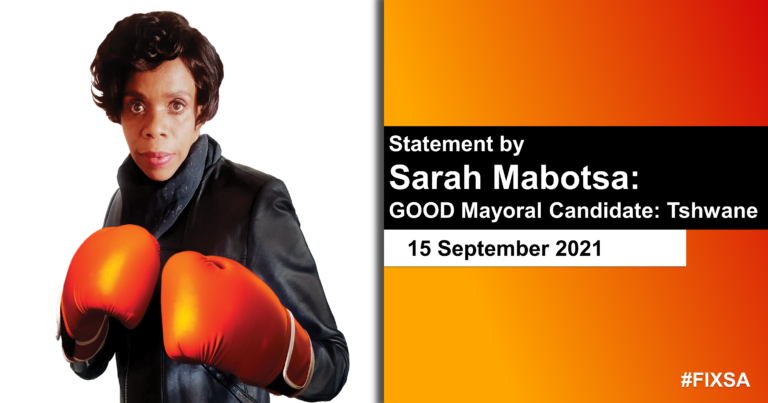
Media Statement by Sarah Mabotsa, GOOD Mayoral Candidate for Tshwane
23 September 2021
I am a professional civil servant. I am not a career politician, but as a resident of Tshwane, I have heard years of promises from our male political leaders.
I remember the ANC’s 2011 promise that they would end corruption and formalise all informal settlements. Instead, they just left us bankrupt. Then the DA came and promised to increase investment and jobs. They just inflated their own salaries and created jobs for pals. Tshwane’s salary bill has increased from R6,9 billion in 2016 to R10.7 billion in 2020.
This extra almost R4 billion salary bill is paid for by us – in higher rates and more expensive electricity. Because of Tshwane’s rising costs, Moody’s downgraded us by four notches this year. More of the same is not going to fix this.
The good news is that with so much wrong, there is a lot that can be fixed. Margaret Thatcher famously remarked that if you want something said, ask a man, but if you want something done, ask a woman.
Here are my six steps for turning Tshwane around in my first 100 days.
One: I will put the processes in place to ensure good governance – and implement consequence management for officials and politicians who are not good. Tshwane lost R2.2 billion to unauthorised expenditure and R6.4 billion to irregular expenditure in the last 5 years.
If Tshwane is going to work, we need competent professionals with real qualifications and experience to run it.
Two: By stopping the billions of wasteful spending, we can reduce water and electricity charges. It is immoral that families must choose between keeping the lights on or buying food.
In the first 100 days, I want to review the tariffs and also ensure that our National Government grants – which provide for R430 of free services for each indigent household per month – are getting to all the households that need them.
The current plan for the city commits to supporting just 3000 indigent households each year – in a city of 1.2 million households. That is only one in every 400 households. Is that really an accurate reflection of poverty in our city? The National government grants are available and we must use them.
Three: Reviewing the IDP – the Integrated Development Plan – means relooking the city’s business plan and prioritising what is important.
Survey data from 2016 showed that 1 in 20 households have no access to water, 1 in 20 no access to electricity and 1 in 5 no access to flush or chemical toilets. These are shocking statistics for our capital city.
Taking savings we make through cutting waste, and reprioritising spending to more essential items, we can deliver faster to those who are still waiting to receive streetlights, electricity, water, roads and toilets.
Four: Even if we can help all our homed residents, homelessness is a feature of any major city. I will go through the City’s property asset register to determine which buildings can help expand shelters and services for the homeless. We must care for, not criminalise, our most needy residents.
Five: Whilst we take steps to stop the rot, we also have to work strategically and look ahead to creating a safer, more affordable city. Towns and cities account for just 2% of the land, but 70% of the world’s air pollution. So cities have a critically important role in combatting climate change.
We need to accelerate our transition to renewable electricity sources. In 2015, Tshwane promised to achieve 50% renewable energy by 2030. One third of the time has gone – we must do more, faster.
Six: Another way to help our residents – and reduce climate change – is to shift more commuters to public transport. GOOD will implement free-off peak public transport. Our buses run empty in the middle of the day, whilst people travel long distances and pay high transport costs to get to work. These commutes are the hidden tax of apartheid spatial injustice. We must help ease that suffering.
The plan, already partially piloted by GOOD’s Secretary-General Brett Heron in Cape Town, is proven possible and financially feasible. Free off-peak public transport also will help pensioners to get to clinics, grant offices and shops easily – and job-seekers get to job interviews.
These six steps will put Tshwane on the good path so that we can make our city work – and make it a place that investors want to come to and create more work for our people.
For media inquiries, please contact:
Ms Sarah Mabotsa, GOOD Mayoral Candidate for Tshwane
Cell: 064 684 8640
Ms Karabo Tledima, GOOD Media Manager
Cell: 061 794 3819
Email: karabot@forgood.org.za